
Difficult-Alloy Precision CNC Machining
Seawater-Resistant Alloy Parts
Precision CNC machining of corrosion-resistant, high-value components for marine, offshore and coastal environments. AXALLOY Precision partners with international engineering, procurement and quality teams to deliver seawater-resistant alloy parts from prototype through controlled low-volume and repeat production.
Based in Shenzhen, we specialize in difficult-to-machine alloys and complex geometries, providing process control, inspection evidence and dependable communication for critical applications.
Why AXALLOY for seawater service
-
Difficult-alloy experts
Nickel alloys, titanium, duplex/super duplex stainless, copper-nickel and specialty cobalt/nickel materials.
-
Complex geometry capability
3-axis, 4-axis and 5-axis milling, turning, mill-turn and Swiss turning for thin walls, tight interfaces and demanding profiles.
-
Controlled process
Material behavior, geometry, tolerances, surface requirements and inspection strategy are evaluated before defining the machining route.
-
Documented quality
Traceable materials, first article inspection (FAI), dimensional reports and project-specific quality records.
-
End-to-end support
DFM feedback, tolerance review, fixture planning, special processes and export-ready packaging.
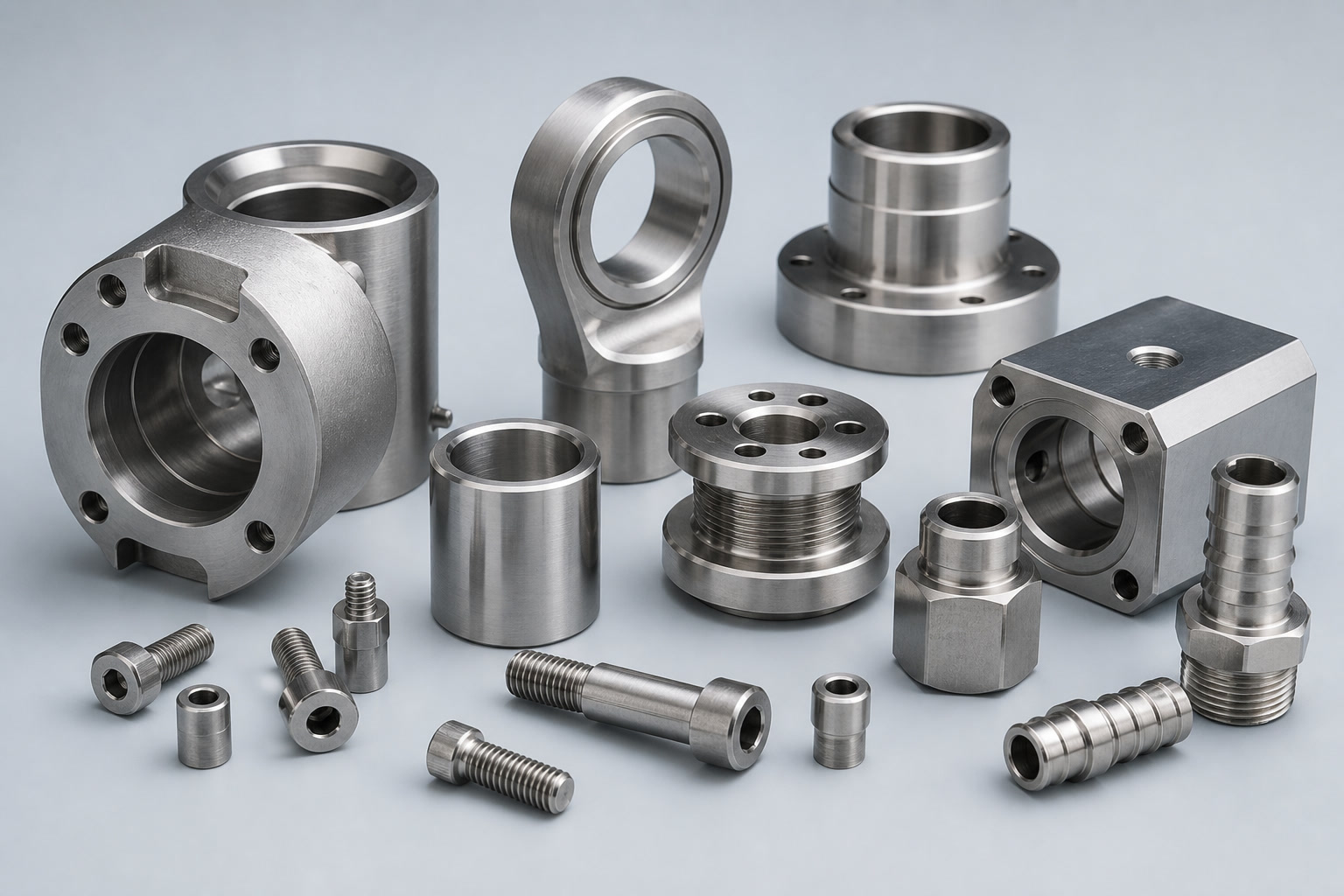
Materials for seawater environments we machine
We select and machine alloys known for resistance to pitting/crevice corrosion, chloride stress corrosion cracking and galvanic attack.
Nickel-based and specialty alloys
Inconel 625, 718; Hastelloy C-276, C-22; Monel 400, K-500; MP35N, Waspaloy, Nimonic.
Titanium alloys
Grade 2 (CP Ti), Grade 5 (Ti-6Al-4V), Grade 23.
Stainless and duplex stainless steels
316L, 17-4 PH, 15-5 PH; Duplex 2205, Super Duplex 2507; Nitronic 50/60.
Copper-nickel and specialty metals
Cu-Ni alloys for seawater service; cobalt-based alloys (e.g., L605).
Typical pairing guidance
Highest chloride resistance
Titanium Grades 2/5/23, Hastelloy C-276/C-22, Inconel 625.
Strength + seawater resistance
Duplex 2205, Super Duplex 2507, Monel K-500, MP35N.
Balanced cost-performance
316L, Nitronic 50, Cu-Ni alloys for heat exchangers and seawater systems.
Note: We can machine to your specified grade and condition; we provide material traceability and mill certificates upon request.
Typical seawater-resistant components
- •Pump, valve and manifold bodies; seats; cages; stems; nozzles; impellers
- •ROV and subsea housings; pressure vessels; connector shells; bulkhead penetrators
- •Shafts, sleeves, bushings, wear rings and precision fasteners
- •Marine hardware: brackets, clevises, lugs and structural interfaces
- •Heat-exchanger end caps, plates and tube-sheet features
- •Sensor bodies, instrument enclosures and transducer mounts
Machining capability at a glance
- Milling: 3/4/5-axis; up to 1000 × 600 × 600 mm; ±0.005 mm tolerance; Ra 0.8 μm machined; Ra 0.2 μm ground.
- Turning and mill-turn: Ø up to 500 mm; length up to 1000 mm; live tooling; concentricity down to 0.008 mm.
- Swiss turning: Ø up to 32 mm; length up to 300 mm; micro features to M0.8 threads.
- EDM and grinding: Wire and sinker EDM; precision grinding to ±0.002 mm and Ra 0.2 μm.
- Thin walls and difficult holes/threads: Down to 0.5 mm walls; Ø0.5 mm holes; fine threads to M0.8–M1.0.
Core processes
Multi-axis milling, turning, mill-turn, Swiss turning; EDM (wire and sinker), precision grinding; special processes including passivation, heat treatment, coating, deburring, marking, cleaning and assembly support.
Engineering and DFM for seawater parts
We collaborate early to balance corrosion performance, manufacturability and cost.
Material selection trade-offs
Strength vs. corrosion vs. weight for seawater service.
Tolerance and datum strategy
For sealing interfaces and modular subassemblies.
Surface finish guidelines
For sealing and sliding surfaces down to Ra 0.2 μm ground.
Thread strategy
Anti-galling solutions via material pairing, coatings or thread forms.
Galvanic management
Material compatibility, insulating bushings/washers if specified.
Crevice-aware design
Drain paths, radii and surface finishes to reduce stagnant zones.
Fixture planning
For thin walls and long seals; cutting strategies for work-hardening alloys.
Process development
Manufacturing-process development and pilot runs for repeatability.
Quality, inspection and records
-
•
Inspection
CMM up to 700 × 1000 × 600 mm; optical ±0.002 mm; controlled environment.
-
•
Reports
FAI, full dimensional, ballooned drawings, surface roughness.
-
•
Traceability
Material test/mill certificates, lot control and special-process records.
-
•
Documentation
Project-specific documentation available on request; inspection photos upon request.
-
•
Calibration
In-process and final inspection; calibration-maintained measurement equipment.
Industries and project fit
Best-fit industries
Marine and offshore, oil and gas, energy, desalination and water processing; aerospace and defense (marine subsystems), robotics and automation; semiconductor and precision industrial equipment exposed to saline environments.
Best-fit projects
- • Complex geometry, thin walls, critical interfaces and precise sealing surfaces
- • High-value prototypes, low-volume or high-mix production, repeat programs
- • Parts requiring certification, FAI, dimensional reports and export-ready packaging
- • Transfers from unreliable suppliers requiring stabilization and documentation
Lead times and engagement
5–10
Prototype (business days)
10–20
Standard production (business days)
1–10,000+
Quantities; MOQ: 1 part
Available
Expedited service
RFQ inputs we support
- • 3D: STEP, IGES, X_T/X_B, SLDPRT, SAT
- • 2D: PDF, DWG, DXF
- • Images: JPG, PNG, TIFF; compressed ZIP/RAR; up to 500 MB per RFQ
- • Units: Metric and imperial
- • Include material, critical features, tolerances, quantities, required documentation and target dates for the most accurate quote
Seawater-focused design tips
- •Specify corrosion-critical features and environments (static vs. flowing seawater, temperature, chlorides).
- •Define sealing surfaces with target Ra and flatness; call out O-ring grooves and datum scheme.
- •Consider anti-galling strategies for stainless-on-stainless threads (coatings or dissimilar pairs such as MP35N/Monel or Ti/Monel where appropriate).
- •Avoid unintended crevices and stagnant zones; add reliefs and drain features.
- •For galvanic couples, specify isolators or compatible alloys; avoid large cathode/small anode area ratios.
- •If applicable, note standards or customer specs for documentation and acceptance criteria.
Get started
Share your 2D drawings and 3D models along with material and documentation requirements. Our engineers will review manufacturability and corrosion considerations and provide a clear, controlled production route for your seawater-resistant alloy parts.