
Material Selection Guide
17-4 PH vs 15-5 PH Stainless Steel: Which Is Better for Precision CNC Machining?
Choosing between 17-4 PH and 15-5 PH often comes down to a practical question: which material will deliver the required strength, corrosion performance, dimensional stability, and inspection confidence—without surprises in machining and heat treatment?
AXALLOY Precision machines both alloys for international engineering, procurement, and quality teams—supporting projects from prototypes to controlled repeat production, with documentation such as MTR/Mill Certs, CoC, FAI, and full dimensional reports.
Quick Summary: 17-4 PH vs 15-5 PH
The table below highlights the key differences between these two precipitation-hardening stainless steels from a buyer's perspective. Note that actual performance depends on heat treatment condition, section thickness, surface finish, and service environment—always verify against your drawing and specification.
Key takeaway: If your specification prioritizes toughness consistency and critical parts, 15-5 PH is frequently chosen. If cost and lead time dominate and requirements are moderate, 17-4 PH often wins.
| Topic | 17-4 PH | 15-5 PH |
|---|---|---|
| Typical Use | General-purpose PH stainless; widely specified | Higher toughness consistency; aerospace-quality requirements |
| Strength (Heat Treated) | High (varies by condition H900–H1150) | High (similar range by condition) |
| Toughness / Ductility | Good; can be more variable depending on section and processing | Often more consistent toughness and transverse properties |
| Machinability | Good for PH stainless; condition-dependent | Similar; often behaves slightly more predictably |
| Corrosion Resistance | Good; common in harsh industrial environments | Comparable; sometimes slightly better in some conditions |
| Availability / Cost | Usually more common and cost-effective | Can be slightly higher cost / less common |
What They Are (In Plain Terms)
Both 17-4 PH and 15-5 PH are precipitation-hardening stainless steels used when you need:
- High strength for demanding structural applications
- Good corrosion resistance for harsh service environments
- Dimensional stability after heat treatment (when properly planned)
- A path to repeatable properties through controlled aging conditions (e.g., H900, H1025, H1150)
Common Applications
Aerospace and automation hardware
Semiconductor equipment components
Valve parts, fittings, shafts, and high-strength brackets
Medical and precision industrial assemblies
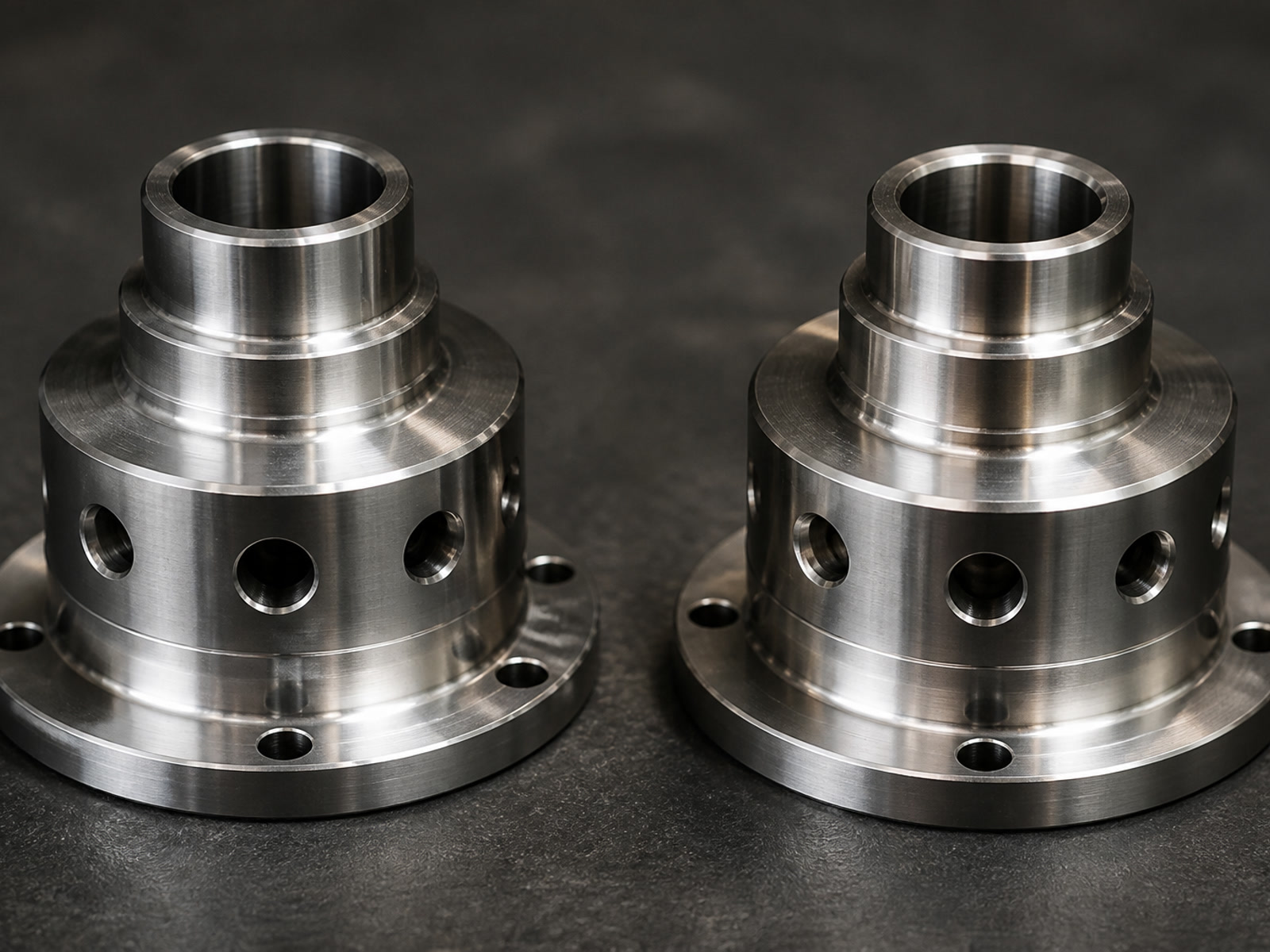
The Real Decision Driver: Heat Treat Condition (H900–H1150)
In procurement and engineering reviews, the "17-4 vs 15-5" debate often becomes secondary to selecting the correct aging condition. The heat treatment specification determines the final mechanical properties more than the alloy choice itself.
H900
- Higher strength and hardness
- Typically lower toughness
- Suitable for wear-resistant applications
H1025 / H1075
- Balanced strength and toughness
- Most commonly specified range
- Good general-purpose performance
H1150
- Improved toughness and stress corrosion cracking resistance
- Lower strength compared to H900
- For critical service environments
If your part has thin walls, sharp transitions, tight positional tolerances, or critical sealing/bearing interfaces, the heat treat and process route should be defined early—including whether to rough machine → heat treat → finish grind/machine.
AXALLOY approach: we review material behavior, geometry, tolerances, surfaces, inspection strategy, and volume before locking the manufacturing plan.
Machining Considerations for Precision Parts
Both alloys are well within AXALLOY's difficult-alloy scope, but PH stainless parts can fail quality requirements if the process is not planned around distortion and feature relationships. Here are the key considerations we commonly address:
1. Distortion Control & Setup Strategy
PH stainless can move after heat treat and even after aggressive material removal. For tight GD&T:
- Reduce setups with 5-axis or mill-turn where applicable
- Use stable fixturing and controlled rough/finish sequencing
- Plan datum strategy to protect critical interfaces
2. Thin Walls & Small Features
AXALLOY typical capability supports:
3. Surface Finish Targets
Typical achievable finishes (application-dependent):
Machined:
Ra 1.6 μm standard
Ra 0.8 μm precision
Ground:
Down to Ra 0.2 μm
If your drawing calls out sealing surfaces or bearing fits, we can integrate precision grinding into the route.
When 17-4 PH Is a Better Fit
17-4 PH is often the practical choice when:
- 1 The design is already proven and widely specified
- 2 Cost/availability and delivery time are key constraints
- 3 You need high strength with standard corrosion resistance
- 4 The part is not extremely notch-sensitive or toughness-critical
Typical Part Types
Brackets, housings, general shafts, industrial fittings, structural components
When 15-5 PH Is a Better Fit
15-5 PH is often chosen when:
- 1 You need more consistent toughness/ductility, especially in challenging geometries
- 2 Aerospace-style requirements push for tighter material/process control
- 3 You want to reduce risk of cracking or variability across lots/sections
- 4 The component has critical features and high consequence of failure
Typical Part Types
Flight hardware components, precision actuator parts, high-value assemblies, critical load-bearing components
Quality, Inspection, and Documentation
AXALLOY is best suited for customers who value manufacturability + process control + documentation, not just lowest unit price.
Inspection Capabilities (High Level)
CMM Range
700 × 1,000 × 600 mm
CMM Accuracy
1.8 + L/300 μm
Optical Measurement Accuracy
±0.002 mm
Environment
Controlled inspection environment
Common Deliverables for 17-4 / 15-5 Programs
Material Test Report (MTR)
Mill Test Certificate
Certificate of Conformance
CoC
First Article Inspection
FAI
Ballooned Drawing
Full dimensional report
Heat Treatment Certificates
Coating certificates when required
Lot Traceability
Project-specific quality records
If you're transferring a repeat program from an unreliable supplier, we can support a controlled launch with defined inspection plans and stable process routing.
AXALLOY Precision Machining Capabilities Relevant to PH Stainless
Milling
3-axis / 4-axis / 5-axis milling for complex contours and thin walls
Turning
Turning and mill-turn to reduce setups and preserve feature relationships
EDM
Wire and sinker EDM for sharp internal features and difficult cavities
Precision Grinding
For tight fits and superior surface finish
Production Volume
Prototype to 10,000+ parts with controlled repeat production
Tolerances
Standard ±0.010 mm, precision down to ±0.005 mm (feature-dependent)
RFQ Checklist: Helps Us Quote the Correct Alloy and Condition
To evaluate 17-4 PH vs 15-5 PH for your part, include the following in your inquiry:
2D Drawing + GD&T
Critical features clearly identified
3D Model
STEP preferred
Material & Condition
17-4 PH or 15-5 PH, and condition (e.g., H900/H1025/H1150)
Quantity & Timeline
Prototype / low-volume / repeat, and target date
Surface & Finishing
Surface finish requirements (Ra) and special processes (passivation/coating)
Documentation Needs
MTR, FAI, full dimensional, etc.
Supported formats: STEP/STP, IGES/IGS, X_T, SLDPRT, SAT, PDF, DWG/DXF (up to 500 MB per RFQ)
Talk to AXALLOY About Your 17-4 PH or 15-5 PH Part
If you're deciding between 17-4 PH vs 15-5 PH, we can review your drawing for:
- Machinability and distortion risk
- Tolerance stack and datum strategy
- Recommended process flow (including heat treat + finish operations)
- Inspection plan aligned to your quality requirements
AXALLOY Precision (Shenzhen) supports international engineering, procurement, and quality teams from prototype development through repeat production of difficult-alloy components.