
Shenzhen, China — Difficult-Alloy Precision CNC Machining
316L Stainless Steel Turning — Prototype to Repeat Production
We machine precision 316L stainless steel turned and mill-turn components with tight tolerances, process control, and complete documentation. Request an RFQ to move from drawing to dependable production.
- Location
- Shenzhen, China
- Focus
- Difficult alloys and complex geometries
- Volumes
- 1–10,000+ parts
- Lead time
- 5–10 business days (prototypes), 10–20 (standard), expedite available
Why work with us for 316L stainless steel turning
We're a CNC machining partner purpose-built for high-value, high-reliability components—not commodity price shopping. On 316L stainless steel, we control the variables that matter:
-
Stable machining of gummy, work-hardening 316L: tuned feeds/speeds, sharp tooling, chip control and coolant strategy for consistent size and finish.
-
Tight feature relationships: mill-turn and 5-axis support for critical coaxiality, flats, cross-holes and off-center features in one controlled route.
-
Surface integrity: burr control, edge conditioning, deburring and optional passivation, cleaning and marking per project requirements.
-
Dimensional consistency: controlled fixturing, in-process inspection and documented setups for repeat runs.
If you value manufacturability, process control, traceability and responsive communication, we're a strong fit.
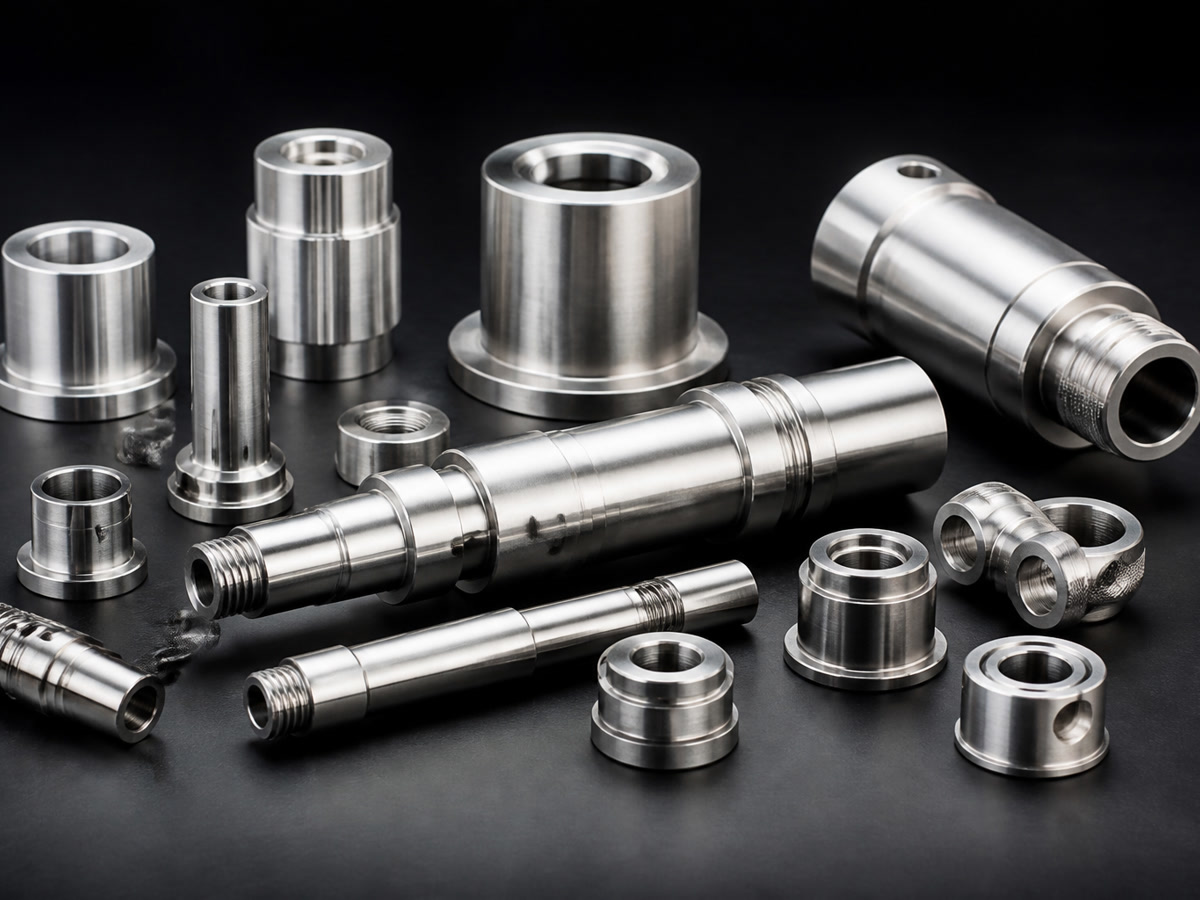
Typical 316L turned parts we deliver
Valve and pump components
Bodies, nozzles, seats, stems, sleeves, fittings
Sanitary and medical hardware
Connectors, manifolds, housings, surgical instrument subcomponents
Semiconductor and vacuum
UHP fittings, adapters, sensor housings
Marine and food equipment
Shafts, bushings, spindles, threaded components
Instrumentation and robotics
Precision pins, collars, couplings
Capability snapshot for 316L stainless steel turning
Turning and mill-turn
- Max turning diameterØ500 mm
- Max turning length1,000 mm
- Max bar capacityØ80 mm (turning), Ø65 mm (mill-turn)
- Tolerance (typical best)±0.005 mm
- Concentricitydown to 0.008 mm
- Roundnessdown to 0.005 mm
- Surface finishRa 1.6 μm std; Ra 0.8 μm machined; Ra 0.2 μm ground
- FeaturesTurning, facing, grooving, threading, boring, cross-drilling, off-center milling and tapping
For small, high-precision 316L parts — Swiss CNC
- Bar sizeØ0.5–32 mm
- Max length300 mm
- Tolerance±0.005 mm
- ThreadsM0.8+
Complementary processes
Precision grinding (down to ±0.002 mm), wire and sinker EDM for sharp internal features or hardened inserts, heat treatment (as specified), passivation, coating, deburring, marking, cleaning and assembly support.
Inspection and control
- EnvironmentTemperature-controlled inspection room
- CMMup to 700 × 1,000 × 600 mm
- Optical measurement±0.002 mm
- Inspection stagesFirst article, in-process, final
Material focus: 316L and beyond
316L is a core material in our difficult-alloy portfolio. We routinely machine:
-
Austenitic and precipitation-hardening stainless steels: 316L, 304, 321, 15-5 PH, 17-4 PH
-
Nickel-based superalloys: Inconel, Hastelloy, Monel
-
Additional materials: titanium alloys, duplex/super duplex, cobalt alloys, A286 and specialty metals
This breadth helps us select tools, parameters and inspection strategies that keep 316L projects stable and repeatable.
Engineering support that reduces total supply risk
-
Drawing and tolerance review with practical feedback on datum schemes, GD&T and surface requirements
-
DFM to stabilize thin walls, threads, deep bores and intersecting features
-
Fixture and process planning that minimizes setups and stack-up error
-
Pilot runs for process validation and repeat-production control plans
Quality and documentation you can rely on
Material traceability
Material Test Report (MTR) / Mill Test Certificate (MTC) available
First Article Inspection
FAI and ballooned drawings on request
Full dimensional reports
Dimensional inspection reports and surface roughness data
Special process records
Heat treatment, passivation, coating records
Certificate of Conformance
Project-specific documentation packs and inspection photos available
Industries we serve
Aerospace, medical devices, semiconductor equipment, energy, oil and gas, marine, robotics, automation and precision industrial equipment.
We work with OEMs, Tier 1/2 suppliers, engineering firms, contract manufacturers and product development teams across North America, Europe, the UK, Australia, New Zealand and advanced Asian markets.
When we're the right fit
-
Complex geometry, thin walls, critical interfaces or tight geometric tolerances
-
High-value prototypes, low-volume or high-mix production and repeat programs
-
Clear drawings and models, defined materials, identified critical features, documented requirements and realistic delivery dates
If you're buying purely on lowest unit price with incomplete specs, we're likely not the right supplier.
RFQ checklist for 316L stainless steel turning
To quote quickly and accurately, please include:
-
2D drawing (PDF) with complete tolerances and notes
-
3D model (STEP/IGES/Parasolid) for complex geometry
-
Material: 316L stainless steel (specify any variant or special requirements)
-
Quantities by lot and any repeat forecast
-
Critical features, threads, surface finish, and inspection points
-
Required documentation (e.g., MTR/MTC, FAI, full dimensional report)
-
Target delivery date and any export/packaging instructions
Supported files
STEP, STP, IGES, IGS, X_T, X_B, SLDPRT, SAT, PDF, DWG, DXF, ZIP/RAR, JPG/PNG/TIFF
Max upload per RFQ: 500 MB
Drawing units: metric and imperial
Lead time and delivery
- Prototypes5–10 business days
- Standard production10–20 business days
- Expedited serviceAvailable upon request
- Volumes1–10,000+ parts
FAQs — 316L stainless steel turning
How tight can you hold on 316L?
We routinely achieve ±0.005 mm on critical turned features with roundness down to 0.005 mm and concentricity down to 0.008 mm, subject to geometry and inspection strategy.
What surface finishes are typical?
Ra 1.6 μm is a common machined finish; down to Ra 0.8 μm with optimized cutting and to Ra 0.2 μm when ground. We'll align finish with functional requirements.
Can you passivate and document it?
Yes. Passivation and cleaning are available, with special process records included per your documentation pack.
What's the smallest thread or hole you support?
Threads down to M1.0 on turning, and down to M0.8 on Swiss CNC. Minimum drilled hole typically Ø0.5 mm.
Do you provide material and lot traceability?
Yes. We provide MTR/MTC, maintain lot traceability, and issue a Certificate of Conformance. Custom documentation is available upon request.
Start your RFQ
Send your drawing set and 3D model with quantity, delivery and documentation requirements. We'll review manufacturability and respond with a clear proposal.
AXALLOY Precision
Precision machining for difficult alloys — from prototype to controlled repeat production.
Shenzhen, China