
Material Selection Guide
Inconel 718 vs Titanium Grade 5 (Ti-6Al-4V): Which Material Should You Choose?
Choosing between Inconel 718 and Titanium Grade 5 (Ti-6Al-4V) often comes down to temperature, strength-to-weight, corrosion environment, and manufacturing risk. Both are premium alloys commonly used in aerospace, energy, medical, semiconductor equipment, and high-performance industrial systems—exactly the kind of work AXALLOY Precision supports.
AXALLOY Precision is a Shenzhen-based CNC machining partner specializing in difficult-to-machine alloys and complex, high-value components—from prototypes to controlled repeat production—with material traceability, inspection evidence, and dependable communication.
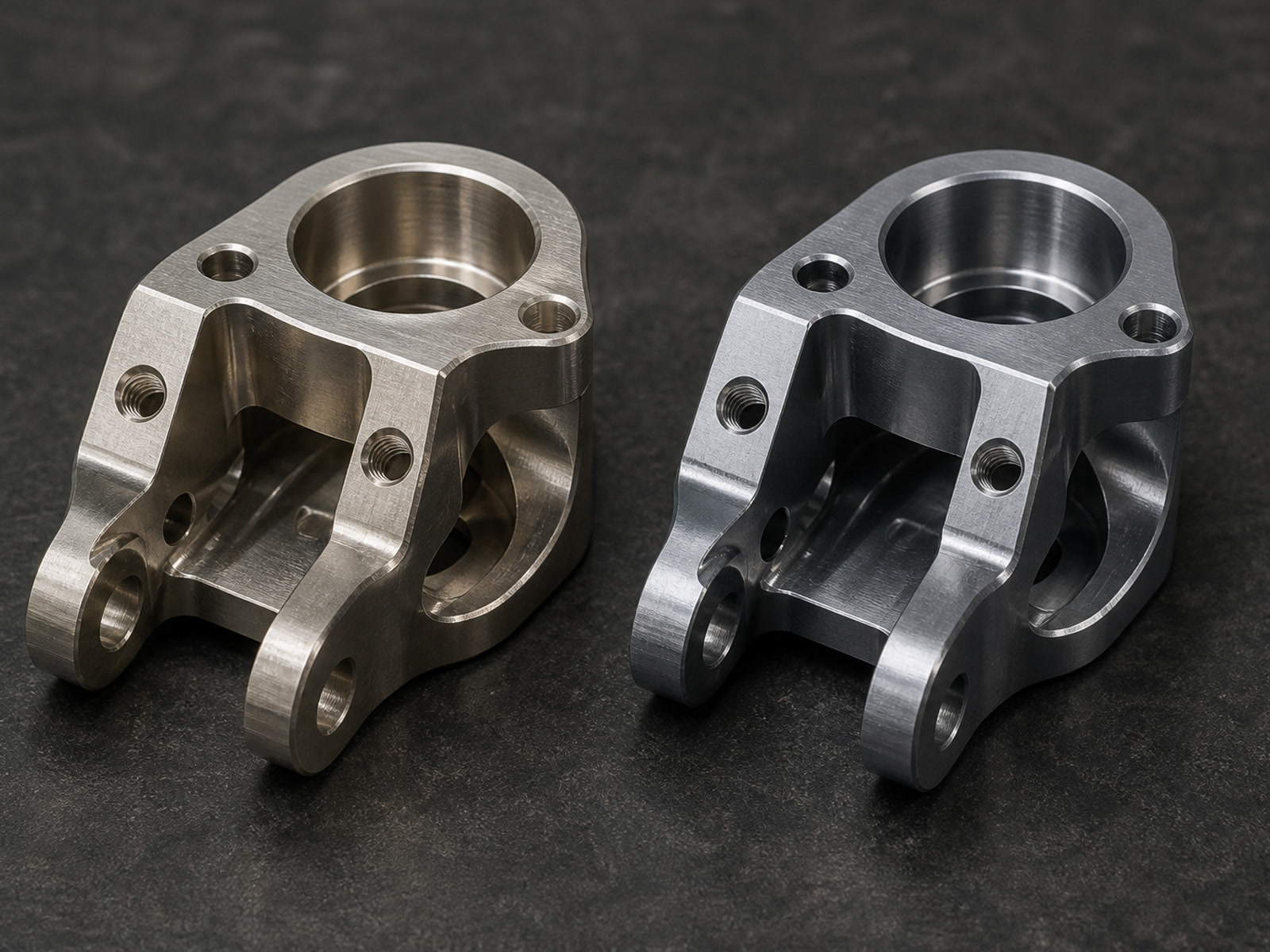
Quick Comparison (Engineering View)
| Category | Inconel 718 | Titanium Grade 5 (Ti-6Al-4V) |
|---|---|---|
| Best reason to choose | High strength at elevated temperature | High strength-to-weight and corrosion resistance |
| Density / weight | Heavy (nickel superalloy) | Much lighter than Inconel |
| High-temperature performance | Excellent (hot-strength, creep resistance) | Limited compared to Inconel at high temperatures |
| Corrosion resistance | Excellent (many aggressive environments) | Excellent (especially chloride/seawater; biocompatible) |
| Machinability | Difficult (work hardening, heat, tool wear) | Difficult (low thermal conductivity, galling) |
| Typical applications | Turbine components, high-temp fasteners, downhole tools | Aircraft structures, medical implants, lightweight housings |
| Cost drivers | Material cost + long cycle times + tool wear | Material cost + chatter control + heat management |
When Inconel 718 Is the Better Choice
Select Inconel 718 when your part must keep strength and stability under high heat and stress.
Common drivers
- Elevated temperature performance and high mechanical load
- Hot-section aerospace/energy components
- Harsh corrosion + temperature combinations
- Programs where long-term reliability matters more than machining time
Typical parts we machine in Inconel 718
- High-temperature housings and manifolds
- Nozzles, fittings, and valve components
- Thin-wall structures with critical interfaces
- Precision turned and mill-turn components with strong feature relationships
When Titanium Grade 5 Is the Better Choice
Choose Titanium Grade 5 when weight matters and you still need high strength and corrosion performance.
Common drivers
- Lightweighting with excellent mechanical strength
- Corrosion resistance in marine/chloride environments
- Medical and high-end industrial designs requiring premium materials
- Parts needing strong performance without nickel-alloy weight
Typical parts we machine in Titanium Grade 5
- Structural brackets and complex milled components
- Precision shafts, sleeves, and connectors
- Robotic/automation components needing stiffness at low mass
- Housings and plates with thin walls and tight positional control
Machining Considerations
What impacts lead time, cost, and risk. Both alloys are "difficult," but they fail differently in machining. The best sourcing outcomes come from a supplier that plans around material behavior, geometry, and inspection strategy.
Inconel 718 machining risks
- Work hardening and high cutting forces
- Tool wear and heat buildup
- Surface integrity concerns on critical features
Titanium Grade 5 machining risks
- Heat concentration at the cutting edge (low thermal conductivity)
- Chatter and deflection on thin walls
- Galling and surface finish sensitivity
AXALLOY approach: we evaluate material behavior, geometry, tolerances, surface requirements, inspection strategy, and production volume before defining the machining process—especially important for thin walls, tight GD&T, and difficult holes/threads.
AXALLOY Precision Capabilities
We support international engineering, procurement, and quality teams from prototype development through low-volume and repeat production for both Inconel 718 and Titanium Grade 5.
Core machining processes
3/4/5-axis CNC milling for complex contours, pockets, thin walls, and precision interfaces
Turning + mill-turn to reduce setups and improve feature relationships
Swiss turning for small precision components (down to Ø0.5 mm)
Wire EDM / Sinker EDM for sharp internal corners, narrow slots, and complex cavities
Precision grinding for sealing surfaces and tight form tolerances
Typical capability highlights
Standard tolerance
±0.010 mm
Precision tolerance
down to ±0.005 mm
Flatness
down to 0.005 mm
grinding down to 0.003 mm
Concentricity
down to 0.008 mm
Surface finish
Ra 0.8 μm machined
Ra 0.2 μm ground
Quality, Inspection & Documentation
Built for regulated and export programs. AXALLOY is best suited to customers who value process control, documentation, and dependable communication—not simply the lowest unit price.
Inspection capabilities
- CMM (700 × 1,000 × 600 mm), accuracy up to 1.8 + L/300 μm
- Optical measurement accuracy ±0.002 mm
- Surface roughness measurement Ra 0.05–40 μm
- Hardness testing (Rockwell/Brinell/Vickers)
- Temperature-controlled inspection room
Documentation available
- Material Test Report / Mill Test Certificate
- Certificate of Conformance
- First Article Inspection Report (FAI)
- Ballooned drawing + full dimensional reports
- Surface roughness report
- Heat treatment and coating certificates (when required)
- Material and lot traceability, special process records
Which One Should You Use?
Practical selection rules for deciding quickly:
Choose Inconel 718 if the part sees high temperature or must hold strength under heat.
Choose Titanium Grade 5 if the part must be lightweight and strong with excellent corrosion resistance.
If your design has thin walls + tight GD&T, the deciding factor is often machining stability and inspection strategy—we can review both and recommend the lower-risk route.
Why AXALLOY for Inconel 718 and Titanium Grade 5 Programs
Focus on difficult alloys (nickel superalloys + titanium)
Strong fit for high-value prototypes, low-volume/high-mix, and repeat production
Built for engineering + quality alignment: DFM, tolerance review, fixture planning, and controlled documentation
Inspection evidence and traceability to reduce supplier risk
RFQ: Get a Manufacturable Quote with the Right Controls
To quote Inconel 718 vs Titanium Grade 5 accurately, we recommend providing:
- 2D drawing (PDF) + 3D model (STEP preferred)
- Material grade and spec requirements (e.g., Inconel 718 / Ti-6Al-4V)
- Quantity and expected repeat volume
- Critical features / GD&T and surface finish requirements
- Required documentation (MTR, FAI, full dimensional, etc.)
- Target date and any packaging requirements
Supported file formats: STEP/STP, IGES/IGS, X_T, X_B, SLDPRT, SAT, PDF, DWG, DXF (up to 500 MB per RFQ).
Request a Quote / Engineering Review
Send your drawings and requirements, and we'll respond with manufacturability feedback, lead time, and a controlled process route for either Inconel 718 or Titanium Grade 5.