
Material Selection Guide
Titanium Grade 2 vs Grade 5: A CNC Machining Guide for Precision Components
When engineering high-performance components for aerospace, medical, or energy applications, titanium is often the material of choice due to its exceptional strength-to-weight ratio and corrosion resistance. However, selecting the right alloy is critical for both product performance and manufacturability.
At AXALLOY, we specialize in the CNC machining of difficult alloys. In this guide, we break down the differences between Titanium Grade 2 vs Grade 5 to help your engineering and procurement teams make informed material decisions for your next project.
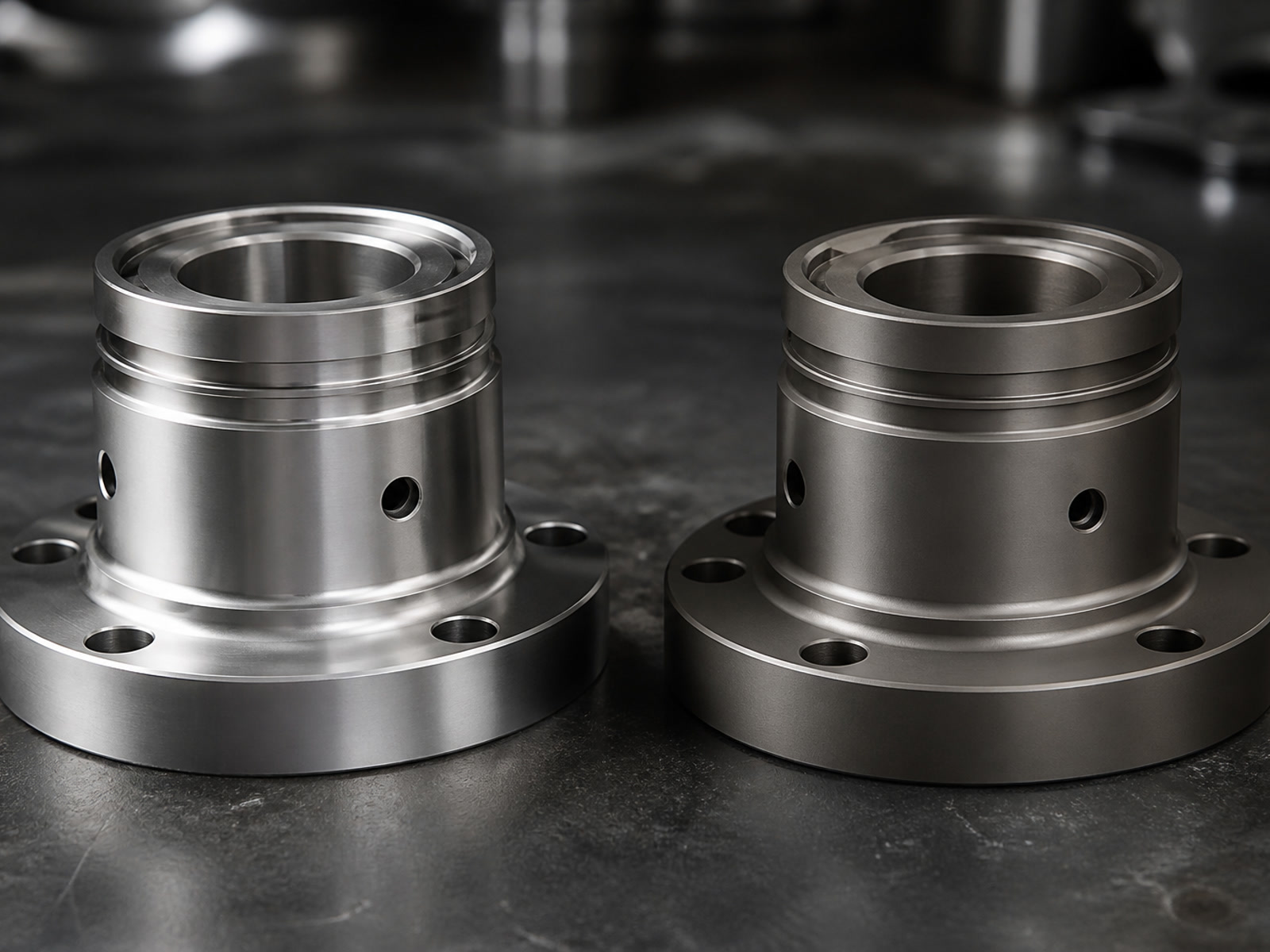
Understanding Titanium Grade 2 (Commercially Pure)
Titanium Grade 2 is an unalloyed, "commercially pure" (CP) titanium. It is widely recognized for its outstanding corrosion resistance, especially in highly oxidizing environments.
Key Characteristics
Excellent weldability, high ductility, and superior corrosion resistance. It is softer and weaker than alloyed titanium but highly formable.
Machinability
While softer, Grade 2 can be "gummy" during CNC machining. It tends to gall and stick to cutting tools, requiring sharp tooling, optimized feed rates, and high-pressure coolant to ensure a clean surface finish (down to Ra 0.8 μm).
Ideal Industries
Chemical processing, marine engineering, medical devices, and oil & gas.
Typical Applications
Valve bodies, pump housings, flanges, and medical instruments.
Understanding Titanium Grade 5 (Ti-6Al-4V)
Titanium Grade 5, also known as Ti-6Al-4V, is the most widely used titanium alloy in the world. It is alloyed with 6% Aluminum and 4% Vanadium, making it significantly stronger than Grade 2 while retaining excellent corrosion resistance.
Key Characteristics
High tensile strength, excellent fatigue resistance, and heat-treatable. It can withstand extreme temperatures and mechanical stress.
Machinability
Grade 5 is notoriously difficult to machine. Its high strength and low thermal conductivity mean that heat concentrates at the cutting edge, leading to rapid tool wear. Machining Grade 5 requires highly rigid CNC setups, rigid workholding, and specialized carbide tooling.
Ideal Industries
Aerospace, robotics, medical implants, and high-performance automotive.
Typical Applications
Turbine blades, aerospace fasteners, orthopedic implants, engine components, and precision structural brackets.
Head-to-Head Comparison: Titanium Grade 2 vs Grade 5
Use this side-by-side reference to evaluate which titanium alloy aligns with your component requirements.
| Property / Feature | Titanium Grade 2 (CP) | Titanium Grade 5 (Ti-6Al-4V) |
|---|---|---|
| Alloy Composition | Commercially Pure (Unalloyed) | 6% Aluminum, 4% Vanadium |
| Tensile Strength | ~345 MPa | ~895 MPa |
| Yield Strength | ~275 MPa | ~828 MPa |
| Hardness (Rockwell C) | ~20 HRC | ~36 HRC |
| Corrosion Resistance | Exceptional (Best for chemical/marine) | Excellent |
| Machinability | Fair (Prone to galling/gumminess) | Difficult (High tool wear, heat generation) |
| Heat Treatable? | No | Yes |
| Relative Material Cost | Lower | Higher |
Specify Grade 2 If:
Your part requires maximum corrosion resistance, extensive welding, or formability, and does not bear extreme mechanical loads.
Specify Grade 5 If:
Your part is subject to high mechanical stress, requires high fatigue strength, or needs to operate in high-temperature environments (e.g., aerospace structures).
Machining Titanium at AXALLOY
Because both Grade 2 and Grade 5 present unique machining challenges, partnering with a manufacturer experienced in difficult-to-machine alloys is vital. AXALLOY operates a state-of-the-art facility in Shenzhen, equipped to handle the rigorous demands of titanium machining—from prototype development (1–20 parts) to controlled batch production (up to 10,000+ parts).
We mitigate tool deflection, vibration, and thermal expansion to achieve critical tolerances on complex titanium geometries.
Discuss Your Titanium ProjectMulti-Axis CNC Milling
3-axis, 4-axis, and 5-axis machining for complex contours, thin walls (down to 0.5 mm), and precision interfaces. Spindle speeds up to 20,000 rpm with rigid BT40/HSK-A63 tapers.
Precision Turning & Mill-Turn
Up to 9-axis mill-turn centers and Swiss CNC turning (up to 7 axes) for complex shafts, medical pins, and aerospace connectors.
Wire & Sinker EDM
For narrow slots, sharp internal corners (down to R0.05 mm), and complex internal profiles that cannot be milled.
Precision Grinding
Cylindrical and surface grinding to achieve ultra-fine surface finishes down to Ra 0.2 μm on titanium bearing fits and sealing surfaces.
Tight Tolerances
Consistently holding dimensional tolerances down to ±0.005 mm and concentricity down to 0.008 mm.
Why OEMs & Engineering Teams Trust AXALLOY
We are built for customers who value manufacturability, process control, and dependable communication over simply finding the lowest unit price. When you source titanium parts from AXALLOY, you are guaranteed:
1. Engineering Support & DFM
We don't just hit "print." We evaluate your 3D models and 2D drawings, providing Design for Manufacturability (DFM) feedback, tolerance reviews, and fixture planning before chips fly.
2. Uncompromising Quality Control
Temperature-controlled inspection rooms equipped with advanced CMMs (Accuracy: 1.8 + L/300 μm) and optical measurement systems.
3. Comprehensive Documentation
We understand the compliance needs of the aerospace, medical, and energy sectors. We provide:
- Material Test Reports (MTR) & Mill Test Certificates
- First Article Inspection Reports (FAI)
- Full Dimensional Inspection Reports (Ballooned Drawings)
- Material and Lot Traceability
- Certificates of Conformance (CoC)
Start Your Titanium Project Today
Whether you are validating a new design in Titanium Grade 2 or moving into low-volume production of critical Titanium Grade 5 components, AXALLOY is your reliable manufacturing partner.
Ready for a quote? Submit your complete 2D drawings (PDF, DWG) and 3D CAD files (STEP, IGES, SLDPRT) today. Please include your material requirements, critical features, required documentation, and target quantities.