
CNC Machining Guide
Titanium Grade 5 vs Grade 23: CNC Machining Guide for Critical Applications
When engineering high-value components for aerospace, medical devices, or advanced industrial equipment, selecting the right titanium alloy is critical to product success. The debate of Titanium Grade 5 vs Grade 23 is one of the most common material selection challenges faced by mechanical engineers and design teams.
At AXALLOY Precision, a Shenzhen-based CNC machining partner specializing in difficult-to-machine alloys, we support international engineering and procurement teams in transforming these tough titanium alloys into complex, ultra-precise components.
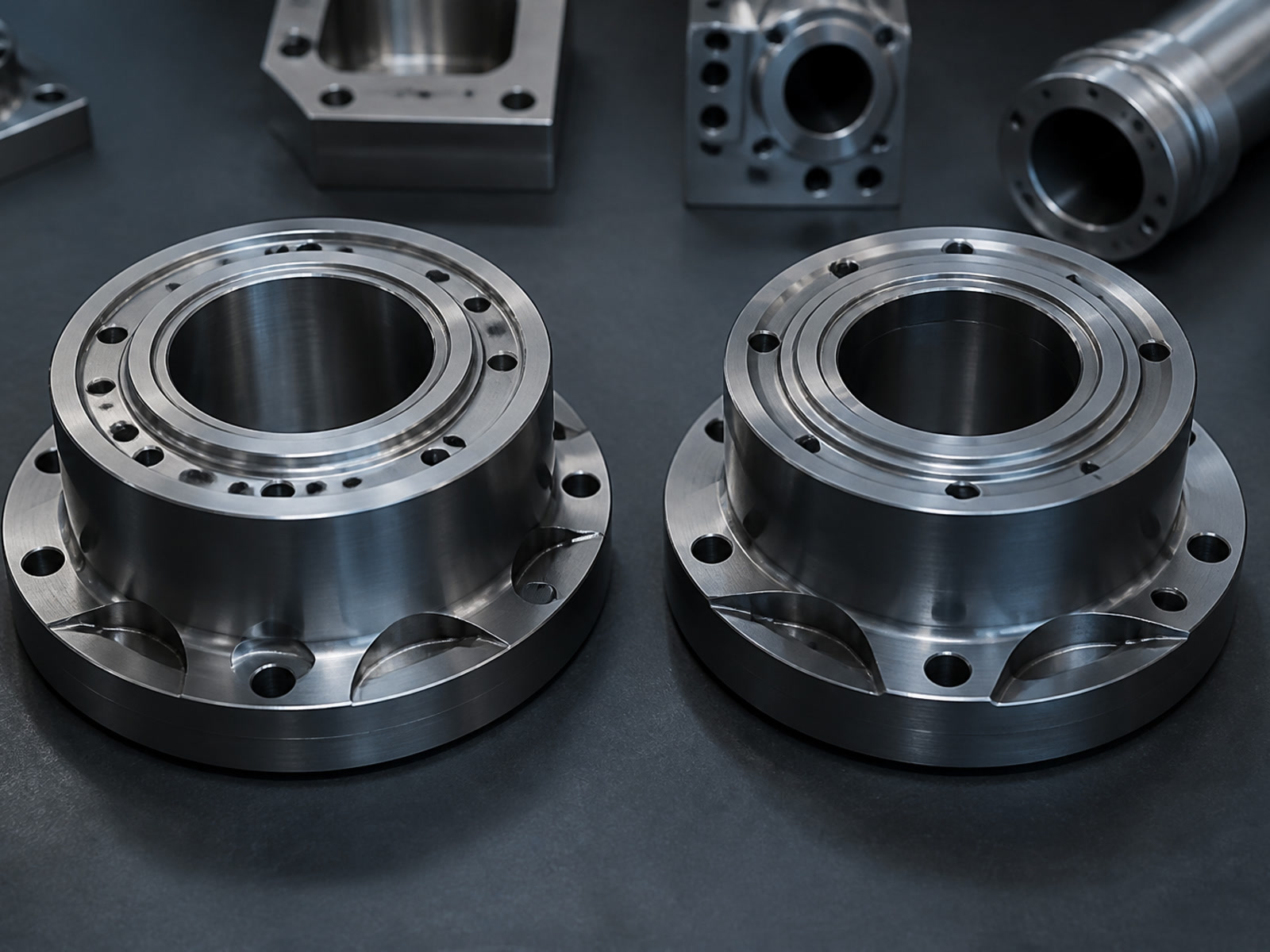
Understanding the Materials: The Core Differences
Both Grade 5 and Grade 23 belong to the Ti-6Al-4V family (6% Aluminum, 4% Vanadium), making them alpha-beta titanium alloys. However, a subtle difference in purity dictates their mechanical behavior and ideal use cases.
Titanium Grade 5 (Ti-6Al-4V)
Known as the "workhorse" of the titanium industry, Grade 5 accounts for over 50% of total titanium usage worldwide.
- • Key Characteristics: Exceptional strength-to-weight ratio, excellent corrosion resistance, and good fatigue strength.
- • Best For: Structural components where maximum strength is the primary requirement.
Titanium Grade 23 (Ti-6Al-4V ELI)
The "ELI" stands for Extra Low Interstitials. Grade 23 is essentially a higher-purity version of Grade 5, with strictly controlled, lower levels of oxygen, carbon, and iron.
- • Key Characteristics: Superior ductility, better fracture toughness, improved fatigue life in aggressive environments, and ultimate biocompatibility.
- • Best For: Medical implants and critical aerospace components where failure is not an option.
| Feature | Titanium Grade 5 | Titanium Grade 23 (ELI) |
|---|---|---|
| Oxygen Content | Max 0.20% | Max 0.13% |
| Tensile Strength | Slightly Higher (~895 MPa) | Slightly Lower (~825 MPa) |
| Ductility & Toughness | Good | Excellent |
| Biocompatibility | Good | Exceptional |
| Primary Markets | Aerospace, Energy, Marine | Medical Devices, Critical Aerospace |
Industry Applications: Which Grade Do You Need?
Matching the right alloy to your project profile is essential for manufacturability and cost-control. AXALLOY routinely machines both grades for OEMs and Tier 1/2 suppliers across global markets.
Medical Devices & Orthopedics
Grade 23
Because the lower oxygen content reduces the risk of rejection by the human body, Grade 23 is the undisputed choice for bone screws, joint replacements, surgical instruments, and dental implants.
AXALLOY supports this with Swiss CNC turning for pins and screws down to Ø0.5 mm.
Aerospace & Defense
Grade 5 & Grade 23
Grade 5 is widely used for brackets, fasteners, and turbine housings. Grade 23 is selected for critical airframe components and cryogenic applications where high fracture toughness is required.
Oil, Gas & Marine
Grade 5
The outstanding corrosion resistance of Grade 5 makes it ideal for subsea manifolds, valve bodies, and ROV housings.
The AXALLOY Approach: Machining Difficult Titanium Alloys
Titanium is notorious for poor thermal conductivity, which causes heat to concentrate on the cutting tool rather than dissipating into the chip. This leads to rapid tool wear, galling, and chatter.
At AXALLOY Precision, we do not just quote a price; we evaluate material behavior, geometry, tolerances, and surface requirements before defining the manufacturing process.
Our Titanium Machining Capabilities
- → Multi-Axis CNC Milling: 3-axis, 4-axis, and 5-axis machining (up to 20,000 rpm) for complex contours, thin walls (down to 0.5 mm), and precision interfaces. We hold milling tolerances down to ±0.005 mm.
- → Mill-Turn & Swiss Turning: Ideal for complex shafts, nozzles, and medical components. Our 9-axis mill-turn centers and 7-axis Swiss lathes allow for off-center machining and cross-drilling in a single setup, ensuring concentricity down to 0.008 mm.
- → Wire & Sinker EDM: For features that cannot be milled—such as narrow slots (down to 0.15 mm), deep cavities, and sharp internal corners (R0.05 mm)—our EDM processes achieve surface finishes down to Ra 0.4 μm without imparting mechanical stress on the titanium.
- → Surface Finishing: Standard machined finish of Ra 1.6 μm, precision finish of Ra 0.8 μm, and precision grinding down to Ra 0.2 μm for critical sealing surfaces and bearing fits.
±0.005
Milling Tolerance (mm)
0.008
Concentricity (mm)
0.15
Min Slot Width (mm)
0.2
Min Surface Ra (μm)
Uncompromising Quality & Traceability
For procurement and quality managers sourcing Titanium Grade 5 and Grade 23, documentation is just as important as the physical part. We understand that unverified materials pose a massive supply risk.
Material Traceability
Full Material Test Reports (MTR) and Mill Test Certificates to guarantee you are getting genuine Grade 5 or Grade 23.
Advanced Metrology
Temperature-controlled inspection using CMMs (Accuracy up to 1.8 + L/300 μm) and optical measurement systems.
Quality Documentation
First Article Inspection Reports (FAIR), full dimensional inspection reports, ballooned drawings, and certificates of conformance.
Partner with AXALLOY for Your Next Titanium Project
Whether you are in the prototype development phase requiring 1–20 parts, or transitioning to low-volume repeat production (20–500+ parts), AXALLOY Precision is built to support your engineering and procurement teams.
We are best suited for customers who value manufacturability, process control, and dependable communication over simply chasing the lowest unit price.
Ready to start?
Our engineering team provides comprehensive Drawing Reviews and DFM feedback to ensure your titanium components are optimized for production.
- ✓ Supported 3D CAD: STEP, STP, IGES, X_T, SLDPRT
- ✓ Supported 2D Drawings: PDF, DWG, DXF
- ✓ Standard Lead Time: 10–20 business days (Expedited service available)
- ✓ Minimum Order Quantity: 1 part
Request a Quote
Submit your RFQ for Titanium Grade 5 or Grade 23 components