
Difficult-Alloy Precision CNC Machining
Precision Robot Components CNC Machining (Prototype to Production)
AXALLOY Precision is a Shenzhen-based CNC machining partner for precision robot components made from difficult-to-machine alloys. I work with engineering, procurement, and quality teams who need parts that assemble correctly the first time, hold tolerances across repeat builds, and arrive with the documentation needed to release parts internally.
If you're preparing a new robot platform, validating a redesign, or stabilizing supply from a previous vendor, I can quote from your 2D/3D data and build a controlled machining route from prototype through repeat production.
What you get when you request an RFQ
Parts that fit and move as intended (not "almost right")
Robot joints, end-effectors, sensor mounts, gear housings, and precision interfaces often fail because of stack-up errors, distortion, or inconsistent datums. I focus on feature relationships and setup strategy (multi-axis and mill-turn where it helps) so your assemblies align and rotate smoothly with fewer shims, rework, and debug cycles.
Typical benefits for you
- More predictable alignment between bores, bearing seats, dowel holes, and mating faces
- Reduced assembly time and fewer iterations during bring-up
- Better repeatability when you transition from prototype to low-volume builds
DFM feedback that reduces risk before chips fly
Before machining, I review geometry, tolerances, wall thickness, internal radii, surface requirements, inspection approach, and expected volumes. You receive actionable DFM suggestions (e.g., corner relief, datum selection, tolerance targeting, tool access changes) that can reduce cost and shorten the iteration loop—without changing the function.
Difficult alloys for real robot duty cycles
Many robot components operate near heat sources, in vacuum/clean environments, or under repeated stress cycles. I routinely machine nickel alloys, titanium, PH stainless, duplex stainless, and specialty metals where tool wear, work hardening, and heat control matter.
Common materials for robotic/automation systems
- Titanium Grade 2/5/23
- 17-4 PH, 15-5 PH, 316L
- Inconel 718/625, Hastelloy C-276/C-22, Monel
- MP35N, Nitronic 50/60, A286
- Select specialty metals (molybdenum, tungsten, copper-nickel, Nitinol)
Speed that helps you hit integration dates
Fast turnaround only matters when it changes your schedule. My prototype lead times support:
- Earlier fit-checks to lock interfaces before ordering long-lead purchased parts
- Faster design-validation loops so your team can converge on stiffness/weight changes sooner
- Shorter line stops when you need replacement parts for a pilot build or field unit
When needed, expedited service is available—quoted with a clear scope and inspection plan so speed doesn't sacrifice release readiness.
Inspection evidence and traceability for controlled builds
For robotic systems going into regulated, safety-sensitive, or high-value installations, you may need more than "parts look good." I support CMM measurement, full dimensional reporting, material certs, and project-specific quality records so your quality team can approve and keep builds moving.
Typical precision robot components I machine
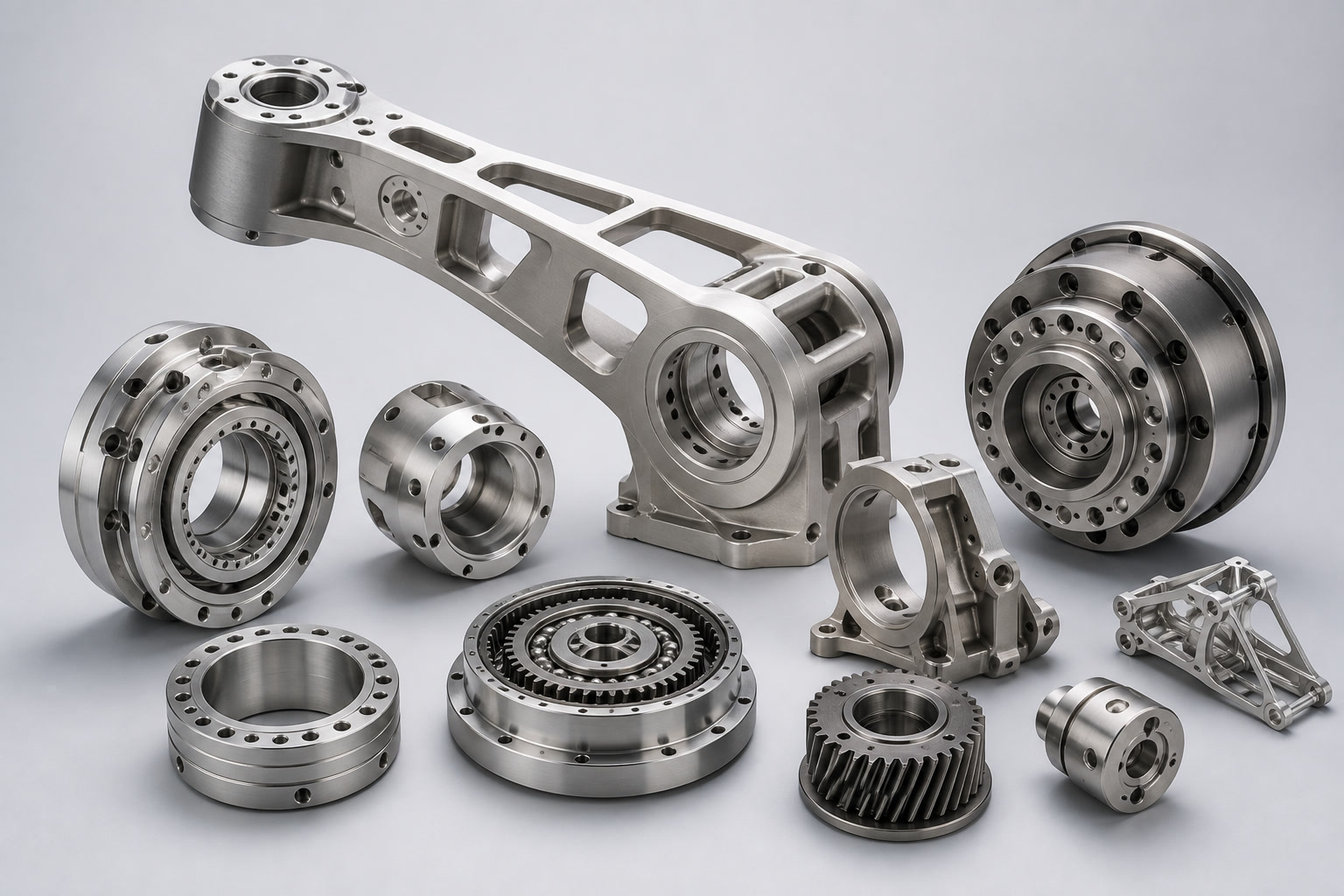
Joint and actuator housings, motor mounts, reducer/gearbox interfaces
Precision brackets, structural links, thin-wall covers and frames
End-effector bodies, gripper components, tool changers
Manifolds, pneumatic/hydraulic blocks, vacuum/flow components
Shafts, sleeves, bushings, pins, nozzles, precision fittings
Sensor mounts, calibration targets, datum fixtures, alignment plates
Capability parameters (for RFQ planning)
General Machining Capabilities
| Supported Production Volume | 1–10,000+ parts |
| Prototype / Low-Volume / Batch | 1–20 parts / 20–500 parts / 500–10,000+ parts |
| Dimensional Tolerance | Standard ±0.010 mm / Precision ±0.005 mm |
| Angular Tolerance | Standard ±0.5° / Precision ±0.1° |
| Position / Flatness / Concentricity | Down to 0.010 mm / 0.005 mm / 0.008 mm |
| Surface Finish | Standard Ra 1.6 μm / Precision Ra 0.8 μm / Ground down to Ra 0.2 μm |
| Min Wall / Min Hole / Min Thread | 0.5 mm / Ø0.5 mm / M1.0 |
| Max Part Weight | 1,000 kg |
| Lead Time / MOQ | Standard 10–20 business days / Prototype 5–10 days / Expedited available / MOQ 1 part |
CNC Milling (3/4/5-axis)
| Max Part Size | 3-axis: 1,000 × 600 × 600 mm 4-axis: Ø500 × 800 mm 5-axis: Ø500 × 400 mm |
| Accuracy | Positioning ±0.005 mm / Repeatability ±0.003 mm Tolerance down to ±0.005 mm |
| Min Corner Radius | R0.3 mm |
| Spindle / Tooling | 20,000 rpm max / up to 60 tools |
| Operations | Facing, contouring, pocketing, drilling, tapping, boring, thread milling |
Turning / Mill-Turn / Swiss
| CNC Turning | Ø500 mm max dia, 1,000 mm length Tolerance ±0.005 mm / Concentricity 0.008 mm |
| Mill-Turn | Up to 9 axes; Ø400 mm × 800 mm Tolerance ±0.008 mm / Live tools 12,000 rpm |
| Swiss CNC | Ø32 mm max bar; 300 mm length Min part Ø0.5 mm / Min thread M0.8 |
EDM & Grinding
| Wire EDM | Accuracy ±0.005 mm / Min cut 0.15 mm Taper ±30° / Ra down to 0.8 μm |
| Sinker EDM | Min corner R0.05 mm / Ra down to 0.4 μm Depth up to 250 mm |
| Precision Grinding | Tolerance ±0.002 mm / Flatness 0.003 mm Ra down to 0.2 μm |
Inspection & Documentation
| CMM | Range 700 × 1,000 × 600 mm Accuracy up to 1.8 + L/300 μm |
| Optical / Roughness | Optical ±0.002 mm Ra 0.05–40 μm / Hardness: Rockwell, Brinell, Vickers |
| Quality Docs | MTR/MTC, CoC, FAI, ballooned drawing, full dimensional report, roughness report, special process records |
Files I can quote from
3D Formats
- STEP/STP, IGES/IGS
- X_T/X_B, SLDPRT, SAT
2D Formats
- PDF, DWG, DXF
Units & Upload
- Metric or imperial units
- RFQ upload up to 500 MB (ZIP/RAR supported)
Special processes
If your robot components require secondary operations, I can support coordination for:
- EDM, precision grinding
- Heat treatment, passivation, coatings
- Deburring, marking, cleaning
- Assembly support (project-dependent)
RFQ checklist
To quote your precision robot components with fewer back-and-forth questions, please include:
- 1 2D drawing (PDF) with GD&T and critical features identified
- 2 3D model (STEP preferred)
- 3 Material grade and condition (e.g., 17-4 PH H900, Ti-6Al-4V, Inconel 718)
- 4 Quantity (prototype + expected follow-on volumes)
- 5 Surface finish requirements (Ra) and cosmetic constraints
- 6 Required documentation (FAI, full dimensional, MTR/MTC, CoC, special-process certs)
- 7 Target delivery date and ship-to country/ZIP
Request an RFQ
Send your drawings and requirements, and I'll respond with:
- A manufacturability review (where helpful)
- A machining and inspection plan aligned to your critical features
- Pricing and lead time options for prototype and repeat production
- Documentation list included in the quote
Request a Quote
Tell us about your component requirements and material challenges.